
Will your new cylinder fit? Same litres can be 600 mm taller
Cylinder capacity does not tell you the shape. Before you order, check the width, height, service clearance and the path the cylinder has to travel.
Last reviewed 2026-09-08
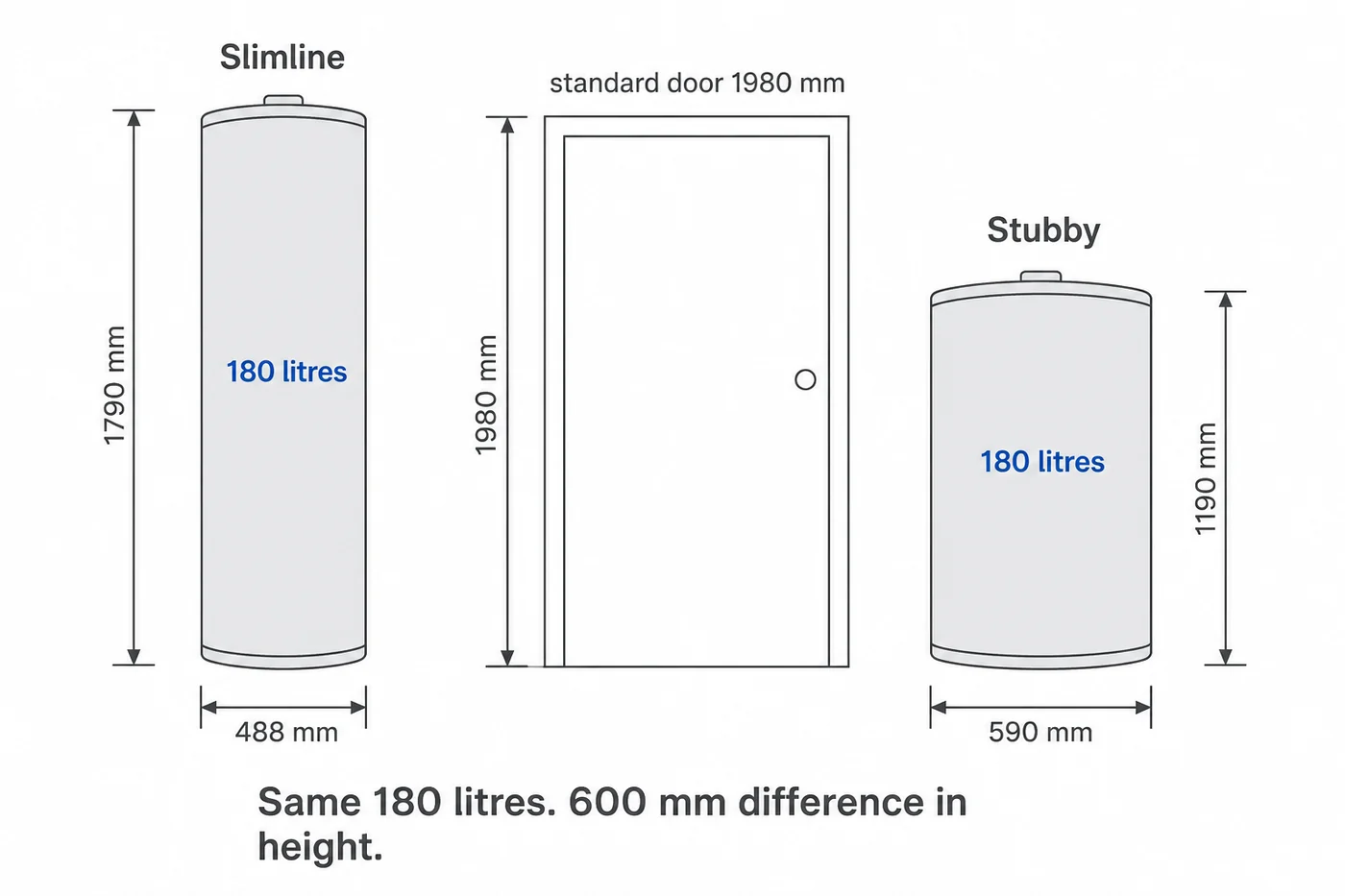
A 180 litre cylinder is anywhere from 1190 mm to 1790 mm tall. The height difference is 600 mm at the same capacity, in the same catalogue, before you have even started comparing brands.
People are often surprised because litres sound like the size. In real life, litres tell you how much hot water the cylinder holds, not whether the cylinder is short and wide, tall and narrow, or somewhere in between. A 180 litre cylinder can be a neat fit under a low ceiling in one version and too tall for the same cupboard in another.
This matters most when the old cylinder has failed and everyone is trying to move quickly. The cupboard, alcove or corner of the garage is already fixed, the pipework may be in a familiar place, and the doorways are the doorways. If the replacement is ordered on litres alone, the surprise often turns up on the day the cylinder arrives.
The good news is that this is easy to reduce to a few checks. You do not need to become a cylinder expert; you need the cylinder dimensions, the space it is going into, and the route it has to take to get there. Then a licensed person can confirm what is sensible on site.
Litres are not shape
The pattern across the range is simple: wider means shorter. A slimline cylinder fits a narrow cupboard by being tall, while a stubby cylinder fits under a low ceiling by being fat. Same water, different shape.
Think of it like packing the same amount of rice into two containers. A narrow jar has to be taller, and a wide bowl can be lower. Cylinders work the same way because the amount of water may be the same, but the steel, copper or stainless tank has to put that water somewhere.
Here is the spread by common capacities in the current range:
- 135L: from 580 x 935 to 488 x 1395. The height spread is 460 mm.
- 177L: from 580 x 1165 to 488 x 1715. The height spread is 550 mm.
- 180L: from 590 x 1190 to 488 x 1790. The height spread is 600 mm.
- 250L: from 590 x 1575 to 550 x 1740.
- 300L: from 580 x 1910 to 550 x 2045.
The format above is diameter x height, in millimetres. Diameter is the width across the round cylinder body, and height is the standing height of the cylinder body. These dimensions are the starting point, not the whole fitting decision.
The 180L examples show why guessing is risky. Three 180L cylinders in the range share a 488 mm diameter and still stand 1715, 1765 and 1790 mm. Although the litres and diameter are the same, seventy five millimetres between brands is enough to matter when there is a shelf, a sloping ceiling, pipework above, or a cupboard head that looked generous until someone measured it.
A 300 litre cylinder is another useful reality check. The range runs up to 2045 mm high. The tallest option is over two metres tall, taller than a standard interior door. The cylinder may stand happily once it is in position, but it still has to come through the property and turn around corners first.
There is no single standard diameter
People often ask for a like for like cylinder, which sounds straightforward. A like for like match can be straightforward, but it is not automatic. The diameters actually used in the range are 488, 510, 550, 560, 580 and 590 mm.
Those numbers are close enough to look harmless on paper and far enough apart to cause trouble in a tight cupboard. A cylinder that is 30 or 40 mm wider can foul a door frame, skirting, a pipe, a drain tray, or the side wall of a cupboard. A cylinder that is narrower may be taller, which moves the problem upward instead.
Shape and price sometimes move together for the same reason. Narrower models often cost more, because getting the same amount of stored hot water into a slimmer cylinder is not just a cosmetic choice. If you are comparing a standard model against a slimline option and wondering why the prices differ, see /guides/why-cylinder-prices-differ.
Measure the space, not just the old cylinder
The old cylinder is useful information, but it should not be the only measurement. The old cylinder may no longer be the closest match in the current range, may have been squeezed into a spot that makes servicing difficult, and may also have had space around it that nobody noticed until a slightly different replacement was chosen.
Start with the available width. Measure the narrowest clear space where the cylinder will stand, not the widest part of the cupboard. If there is a door frame, trim, pipe, valve, power point, shelf support or wall lining sticking into the space, that obstruction is part of the space. Cylinders do not politely pass through timber or copper because the tape measure found a wider spot behind it.
Then measure the available height. Measure from the floor or platform the cylinder will sit on up to the first real obstruction. The obstruction may be the ceiling, a shelf, pipework, a sloping roof line or the underside of a bench. If the floor is not the final level, allow for that. A platform, tray or plinth can change the practical height available.
Now measure the route in. People often forget this one because they picture the cylinder already in place. The cylinder has to get through the doorway, along the hall, around the corner, into the garage or cupboard, and then be stood up. A 300L cylinder at 2045 mm high is not just a tall object once it arrives. The cylinder remains a tall object while someone is trying to manoeuvre it through a building.
Two numbers is not enough
Diameter and height tell you whether the cylinder body is in the right neighbourhood, while clearances tell you whether it can be lived with. A cylinder that fits like a cork in a bottle may still be the wrong choice if it cannot be accessed for servicing.
Rheem stainless instructions require room for TPR valve removal, element cover removal and anode removal and replacement. The TPR valve is the temperature pressure relief valve, a safety valve connected to the cylinder. The element cover gives access to the electrical heating element area. An anode is a replaceable protective rod used in cylinder maintenance. You do not need to service these yourself, but the licensed person who does the work must be able to get to them.
The same instructions also state that no warranty cost is payable where the position forces major dismantling of cupboards, doors or walls. The same applies where the position requires special equipment to bring the unit to a serviceable position. In plain English, space to service it is a warranty condition, not a nicety.
The service-access requirement is the part that catches people out. A cylinder can physically fit into a cupboard and still be a poor fit. If servicing requires pulling apart joinery or shifting the unit into the room, the problem is not just awkwardness. The lack of access can affect warranty support.
Remember the full weight
Weight is another practical issue, especially for platforms, cupboards, older floors and raised installations. We do not yet hold weights for the full range, so it would be wrong to generalise across every model.
One manufacturer figure is useful as an illustration. Rinnai's 180L low pressure copper cylinder is 26 kg empty and 206 kg full. The full number is the one that matters for floors and platforms, because the cylinder does not spend its working life empty.
Do not use that 206 kg figure for other models. Different sizes and materials will differ. The point is simply that stored water is heavy, and a cylinder position needs to be suitable when the cylinder is full.
What about heat pump cylinders?
Monoblock heat pump cylinders are a different shape problem entirely. The unit goes outside and wants clearance around it for airflow and service access. Airflow and service access are not just a taller or wider version of the cupboard question.
If you are looking at a hot water heat pump, use the heat pump guide rather than relying on the measurements in this article. The same habit still helps, though: measure the real space, the route, and the clearances, not just the litres.
Before you order
If your current cylinder has failed, it is tempting to choose the same litre size and get on with the day. The same litre size may work, but it is not enough information on its own. Height is not set by litres. Diameter is not standard. A like for like swap is not automatically a like for like fit.
Use the dimensions to narrow the options, then confirm the site. Hot Water Sorted supplies the cylinder only, so the final decision on what can be fitted safely and legally belongs with the site assessment and the licensed person involved.
Before you ask us to help narrow the choice, send three measurements and a photo:
- Width available: the narrowest clear space where the cylinder will stand.
- Height available: from the standing surface to the first obstruction above.
- Route in: doorway, hallway, garage access, cupboard opening and any tight turns.
- A photo: step back far enough to show the whole cupboard, alcove or corner, including pipes and anything above the cylinder.
Those four pieces of information usually reveal the problem early, while it is still easy to choose another shape. Early discovery is much better than discovering on delivery day that the litres were right, but the cylinder was not.