
The Auckland heat pump cylinder running cost most guides get wrong
Most heat pump cylinder running cost guides still use an electricity price around 28 cents. Using MBIE's May 2026 national average of 42.0 c/kWh changes the arithmetic, and it makes the heat pump saving look stronger, not weaker.
Last reviewed 2026-09-08
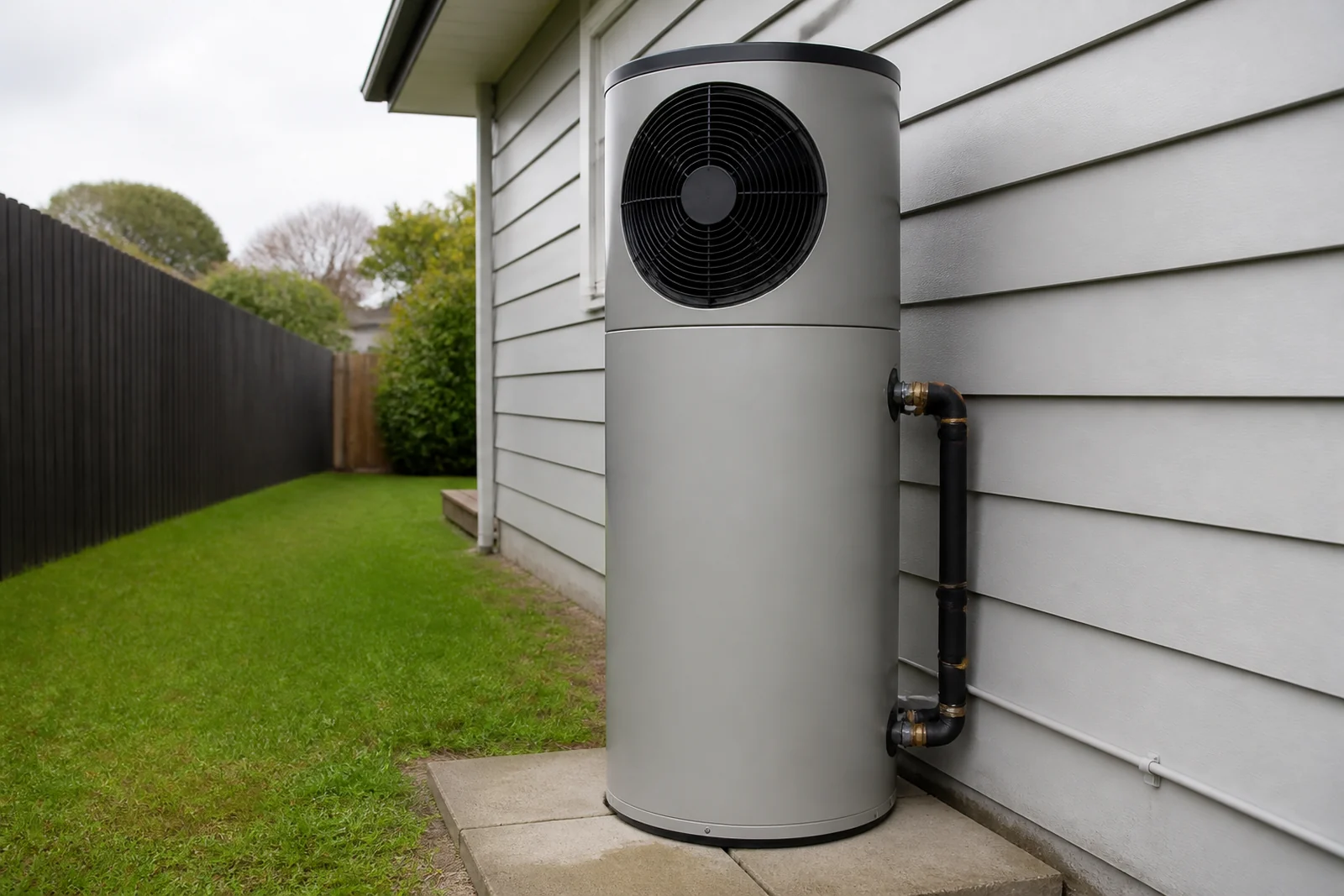
Almost every New Zealand article about heat pump hot water is working from an electricity price that is years out of date. You will often see running costs based on around 28 cents per kWh. MBIE's national average was 42.0 c/kWh at May 2026.
The updated electricity price changes the answer. The yearly running cost of a normal electric cylinder changes, and the saving from a heat pump cylinder changes as well. If you are standing in a laundry looking at a failed cylinder and trying to decide whether a heat pump unit is worth the extra product cost, this is the number you need to test first.
This guide shows the arithmetic. Not a slogan. Not just roughly a third of the power. We will use visible assumptions, show the sums line by line, and then show how to swap in the rate from your own power bill.
The three assumptions used in the worked example
A heat pump cylinder can be a very efficient way to heat water, but the exact saving depends on your house, your tariff, the weather and how much hot water you use. The inputs come first, before the sum.
- Electricity price: 42.0 c/kWh, or $0.42 per kWh. This is MBIE's May 2026 national average from its electricity cost monitoring. MBIE surveys quarterly at the mid point of February, May, August and November, modelling a household using about 8,000 kWh a year.
- Hot water use: 2,500 kWh a year. EECA says water heating is about 30 percent of the average New Zealand household's energy use. A standard electric cylinder in a household of four uses roughly 2,000 to 3,000 kWh a year, so 2,500 kWh is the middle of that range.
- Heat pump efficiency: roughly three times a standard resistive electric cylinder, using EECA's real-world guide rather than the rating printed on a product badge.
Those choices are deliberately moderate. We are not using the highest electricity region. We are not using the top end of the 2,000 to 3,000 kWh hot water range. We are not using a COP of 4.5, even though some specification sheets show numbers around there. The point is to give you a result you can reproduce with a calculator, not the largest possible saving.
One Auckland note matters. Many Auckland consumers receive an annual Entrust rebate, which can make their effective electricity cost sit below the advertised rate. We are not attempting to quantify that here. Use 42 c/kWh for the worked example, then replace it with your own effective rate if you know it.
The four person example, one line at a time
For a household of four, use the mid range hot water assumption of 2,500 kWh a year.
Standard electric cylinder: 2,500 kWh x $0.42 = about $1,050 a year.
A standard electric hot water cylinder uses an electric element, much like a kettle. Almost all of the electricity going in becomes heat in the water, but it is still direct electric heating. If it takes 2,500 kWh to heat your year's hot water, you pay for about 2,500 kWh.
Heat pump cylinder: about 830 kWh x $0.42 = about $350 a year.
The 830 kWh figure is the 2,500 kWh hot water load divided by roughly three. A heat pump does not make heat in the same way an element does. It moves heat from the air into the water, like a fridge working in reverse. The way a heat pump moves heat from the air into the water lets it deliver more heat into the cylinder than the electrical energy it consumes.
Saving: about $1,050 minus about $350 = roughly $700 a year.
The worked case has this headline result: for 3 to 4 people, at MBIE's May 2026 national average electricity price of 42.0 c/kWh, using EECA's roughly three times real-world efficiency guide, a heat pump cylinder saves roughly $700 a year compared with a standard electric cylinder.
The figure remains an estimate. Your result moves if your hot water use is lower, if your tariff is different, if your household changes, or if your cylinder is set up in a way that makes the electric boost element work more often. But the structure of the sum is the same.
The same sum for smaller and larger households
Most guides only show the four person case. The four person case is useful if you are a four person household, and not much help if you live alone or have teenagers taking long showers. Here is the same arithmetic across three household sizes, still using $0.42 per kWh and EECA's roughly three times guide.
- 1 to 2 people: hot water use 1,500 kWh a year. Standard electric is 1,500 kWh x $0.42 = about $630. Heat pump is about 500 kWh x $0.42 = about $210. Saving is about $420 a year.
- 3 to 4 people: hot water use 2,500 kWh a year. Standard electric is 2,500 kWh x $0.42 = about $1,050. Heat pump is about 830 kWh x $0.42 = about $350. Saving is about $700 a year.
- 5 or more: hot water use 3,000 kWh a year. Standard electric is 3,000 kWh x $0.42 = about $1,260. Heat pump is about 1,000 kWh x $0.42 = about $420. Saving is about $840 a year.
The bigger the hot water load, the more electricity there is to save. A larger hot water load does not mean every large household should automatically buy the largest or most expensive unit. Cylinder sizing still matters. Recovery rate matters. Available outdoor space matters. But for running cost, hot water volume is the main lever.
What if your power price is not 42 c/kWh?
This is the part worth doing with your own bill open. The electricity rate changes the answer more than almost anything else.
MBIE's February 2026 survey was about 39 c/kWh nationally, with regions running from roughly 35 c to 49 c. At May 2026 the national average used in this article was 42.0 c/kWh. If you are in a dearer area, or on a dearer plan, the saving is higher. If your effective Auckland cost is reduced by an Entrust rebate, the saving is lower than the same advertised rate would suggest.
Take the four person case again, but use 49 c/kWh, or $0.49 per kWh.
Standard electric: 2,500 kWh x $0.49 = about $1,225 a year.
Heat pump: about 830 kWh x $0.49 = about $408 a year.
Saving: about $1,225 minus about $408 = about $817 a year.
At 49 c/kWh, the same household that saves roughly $700 at 42 c/kWh saves about $817, even though the cylinder and the showers have not changed. Only the electricity price has changed.
To redo the sum with your own rate, use these two multiplications:
- Standard electric annual cost: your hot water kWh x your electricity rate in dollars.
- Heat pump annual cost: your hot water kWh divided by roughly three, then x your electricity rate in dollars.
If your bill shows cents per kWh, divide by 100 to turn it into dollars. For example, 42 c becomes $0.42 and 49 c becomes $0.49.
Why we are not using the rated COP as the saving
COP means coefficient of performance. In plain language, it is a measure of how much heat a heat pump can put into the water for each unit of electricity it uses. A COP of 4.5 sounds like the unit gives 4.5 units of heat for 1 unit of electricity, and the same COP also sounds like the running cost should be less than a quarter of a standard electric cylinder.
The rated COP is not the number we use for the running cost sum.
The manufacturers' own specification sheets show strong rated COPs, but they are measured under stated test conditions. The conditions are not identical across brands, so the headline COPs are not directly comparable.
- Rheem AmbiPower 280e: COP 5.2, at 19 degrees ambient, measured over the whole heat-up.
- Rinnai HydraHeat: COP 4.7, at 19 degrees ambient, 19 degrees water, eco mode 55.
- Haier HP200 and HP250: COP 4.49 and 4.48, at 20 degrees ambient, water 15 to 55.
- Haier HP330: COP 4.00, same conditions.
Those are useful specification figures. They are not the same as your seasonal running cost in Auckland.
Auckland air is below 19 or 20 degrees for a good part of the year. Heat pump water heaters still work in cooler air, but the efficiency is lower than in the rating test. The electric element can also cut in to boost. Below the unit's minimum ambient temperature, the element takes over entirely. The minimum ambient is -7 on the Haier monoblocks, -6 on the AmbiPower, and -15 on the Haier split.
There is another ordinary loss that is easy to forget. A hot cylinder loses heat to the room whatever heated it. Better cylinders manage that loss better, but no cylinder is magic. The cylinder is a hot tank sitting in cooler air, like a mug of tea on the bench.
The gap between badge COP and real-world use is why this article uses EECA's real-world guide of roughly three times a resistive electric cylinder. A badge COP around 4.5 is not a lie, but the figure is just not the same thing as the annual saving you should put into a payback calculation.
What does that mean for payback?
Here we need to be very clear about the limit of the calculation. Hot Water Sorted sells hot water cylinders supply only. We show product prices, not installation labour prices. A heat pump cylinder costs more to install than a like for like cylinder swap, and we do not price installation on this site.
Any payback worked from product prices alone is therefore a floor, not the final answer. In other words, it is the shortest version of the payback calculation before the installation difference is added.
A comparable 250 litre product pair is the Haier heat pump at $4,090 against a Rinnai mains pressure enamel cylinder at $2,480. On product price alone, that gap divided by a $700 a year saving is a little over two years.
Then the honest sentence: add the installation difference and it is longer. We will quote that privately. We will not guess at it in a public running cost guide, because the site does not price installation and every job is different.
This is especially important if your existing cylinder has failed and you need hot water back quickly. The right decision is not only running cost. Product price, installation requirements, available space, household size and how long you expect to own the property all matter.
Who a heat pump cylinder may not suit
A heat pump cylinder is often compelling on running cost, particularly now that electricity prices are higher than many older guides assume. The right answer is not automatically a heat pump cylinder for every house.
- You are selling within a couple of years. The saving accrues to whoever pays the power bill. If you leave before enough bills arrive, you may not personally receive much of the benefit.
- It is a rental where the tenant pays the power. The landlord carries the product cost and the tenant receives the running cost saving. The upgrade can still be a good upgrade, but the payback does not land with the person paying for the cylinder.
- There is no outdoor position for a monoblock. A monoblock heat pump cylinder needs a suitable outdoor location. If you do not have one, look at a split system option. The split also runs down to -15 degrees.
For background on why cylinder prices differ, including linings and warranty, see /guides/why-cylinder-prices-differ. We will also point readers to our monoblock versus split guide once it exists.
The short answer
Using MBIE's May 2026 national average of 42.0 c/kWh, a four person household using about 2,500 kWh a year for hot water spends about $1,050 a year on a standard electric cylinder. Using EECA's roughly three times real-world efficiency guide, a heat pump cylinder uses about 830 kWh and costs about $350 a year to run.
The worked case gives a saving of roughly $700 a year. At 49 c/kWh, the same four person saving is about $817. If your effective rate is lower, including after an Auckland Entrust rebate, your saving is lower.
If you want us to run your numbers, send us your household size and the electricity rate from your bill. We can put your figures through the same arithmetic, with the assumptions visible, so you can see whether a heat pump cylinder makes sense before you buy.